
Compliance Corner
Welcome to the Artesia Community Standards page! Here, you’ll find helpful information regarding the community’s standards and guidelines, along with convenient access to resources designed to help maintain the beauty, safety, and overall appearance of our neighborhood.
If you have questions or need additional assistance, please contact the Association Management Team at ArtesiaTX@CCMCnet.com.
Report a Deed Restriction Violation
To report a potential deed restriction violation, please click here.
Architectural Standards Committee (ASC) Applications
ASC applications are reviewed and processed on Mondays. We encourage homeowners to submit their applications in advance to allow sufficient time for review. Please note that applications are subject to Committee review and approval in accordance with the Association's governing documents.
Architectural Review Committee
Thinking about a new patio cover, fence, paint color, or landscaping update? Now is the perfect time to submit your upcoming projects! Architectural requests can be submitted through our online form:
The Architectural Standards Committee has up to 60 days from receipt of a complete application to respond in writing. Please plan ahead and wait for written approval before starting any work. Verbal approvals do not count.
CC&R Spotlight: Section 6.5, Architectural Approval
“To request architectural approval, an owner must make written application to the Architectural Reviewer and submit 2 identical sets of plans and specifications, drawn to scale, showing the nature, kind, shape, color, size, materials, and locations of the work to be performed… Verbal approval by an Architectural Reviewer, the Declarant, an Association director or officer, a member of the ASC, or the Association’s manager does not constitute architectural approval by the appropriate Architectural Reviewer, which must be in writing.”
“If the applicant… has not received the Architectural Reviewer’s written response – approving, denying, or requesting additional information – within 60 days after delivering his complete application to the Architectural Reviewer, then such application shall be deemed disapproved. If the applicant receives the written approval of the Architectural Reviewer, the owner may then proceed with the improvement, provided he (1) strictly conforms to the requirements and construction specifications contained in this Declaration; (2) strictly conforms to any design guidelines for the Property in effect at the time of application; (3) adheres to the plans and specifications which accompanied his application; and (4) initiates and completes the improvement in a timely manner.”
Basketball Goals & Play Equipment
We love seeing families enjoy the outdoors! To help keep Artesia’s streetscape looking its best, please keep the following in mind for basketball goals and play equipment.
CC&R Spotlight: Section 7.21, Hoops
“Without the Architectural Reviewer’s prior written approval, basketball goals and other recreational or sporting equipment, such as swing sets, may not be used, attached, mounted, or installed in a front yard, on a front driveway, in an unfenced portion of a side yard, or on the street side exterior portion of a dwelling. This prohibition also applies to portable goals and equipment. If the Architectural Reviewer grants approval for such equipment, the approval may be revoked if the equipment is not maintained or used, or if it becomes unsightly.”
In short:
- Basketball goals, including portable goals, may not be placed in the front yard, on the driveway, or in an unfenced side yard without prior written approval.
- Swing sets, playhouses, trampolines, and other play equipment should be kept inside your fenced backyard.
- Play equipment in the backyard should not be readily visible from the street (Section 7.4).
- Approved equipment must be kept in good condition. Approval may be revoked if it becomes unsightly.
Thinking about a basketball goal? Please submit an ASC request before installing: Residential Modification Guidelines. Please also keep goals and equipment out of the street for the safety of players and drivers.
Questions? Contact us at ArtesiaTX@CCMCnet.com or (945) 418-1685.
Exterior Paint & Color Changes
A fresh coat of paint can make a big difference in curb appeal! Whether you’re touching up trim or planning a new color, here’s what to know.
Regular maintenance: Under Section 13.2(a) of the Declaration, each owner must “repair and replace worn, rotten, deteriorated, and unattractive materials” and “regularly repaint all painted surfaces.” This includes trim, shutters, doors, garage doors, and any other painted surface visible from the street.
Repainting the same color? Touch-ups and repainting with the same existing color do not require approval.
Changing a color? Approval is required first.
CC&R Spotlight: Section 7.10, Color Changes
“The colors of buildings, fences, exterior decorative items, window treatments, and all other improvements on a lot are subject to regulation by the Architectural Reviewer… A change or addition of a color that is visible from the street, a common area, special common area or another lot is not permitted without the prior written approval of the Architectural Reviewer.”
This applies to:
- Body, trim, and shutter colors
- Front doors and garage doors
- Fences (clear stain or the original natural cedar tone only)
- Exterior decorative items
Submitting a color change: Please submit an ASC request with paint color names, codes, and samples, and indicate where each color will be used: Residential Modification Guidelines. Please wait for written approval before painting. The committee has up to 60 days to respond, so plan ahead!
Questions? Contact us at ArtesiaTX@CCMCnet.com or (945) 418-1685.
Fence Stain
Fall Fence Refresh
The cooler weather is a great opportunity to get outside and check off items on your “To-Do list,” and that includes freshening up your fence stain! A fresh coat brings your fence back to looking like new, protects the wood, extends the life of your fence, and keeps your curb appeal looking great.
What’s approved for Artesia:
Per the Declaration, fences may only be stained with:
- a clear stain, or the same color stain originally applied by the builder, a natural cedar tone: light-to-medium warm brown, semi-transparent so the wood grain still shows.
- Painted fences and solid, opaque, or other stain colors are not permitted without prior written approval from the Architectural Standards Committee.
CC&R Spotlight: Section 13.2(a), House Maintenance
“Each owner, at the owner’s expense, must maintain all improvements on the lot, including but not limited to the dwelling, fences, sidewalks, and driveways… and must stain fences with a clear stain or with the same color stain as originally applied by the Declarant every two years.”
Garage Doors
Garage doors make up a large part of your home’s front view, so keeping them in good shape goes a long way for curb appeal.
Maintenance: Under Section 13.2(a) of the Declaration, each owner must “repair and replace worn, rotten, deteriorated, and unattractive materials” and “regularly repaint all painted surfaces.” For garage doors, this includes:
- Repairing or replacing dented, cracked, or damaged panels
- Repainting faded, peeling, or chipped paint
- Replacing damaged trim, weatherstripping, or hardware visible from the street
Replacement panels must match. When replacing a panel or section, the new material must match the existing door in style, color, and finish, so the door looks uniform. A mismatched panel color is considered a color change visible from the street, which requires prior approval from the Architectural Standards Committee (Section 7.10).
Replacing the whole door or changing the color? Please submit an ASC request before making any change to the style, color, material, or windows of your garage door: Residential Modification Guidelines. Replacing a door with an identical style and color does not require approval.
Keep it closed: Garage doors are to be kept closed at all times, except when a vehicle is entering or leaving (Section 7.17). Garages must also remain available to park two vehicles.
Questions? Contact us at ArtesiaTX@CCMCnet.com or (945) 418-1685.
Helpful Landscaping Maintenance Links
Maintaining a healthy, beautiful lawn can sometimes be challenging, especially with North Texas’ changing weather conditions. To help make lawn care a little easier, we’ve gathered some helpful online resources with tips and guidance to keep your landscaping looking its best throughout the year!
For the ultimate lawn care guide:
For general lawn care:
For Tree Maintenance:
For Shrub/Plant Maintenance:
For watering your lawn in North Texas:
Texas A&M AgriLife Site - This site has a ton of information and courses on lawn care
Fence Staining:
Do's and Don'ts with Tree Wires:
Holiday Decorations
The holidays are a wonderful time to celebrate together, and we love seeing Artesia homes decorated for the season! To keep things festive and fair for everyone, here's a quick guide to holiday decorations.
Decoration Timeline:
| Holiday | Decorations May Go Up | Decorations Must Come Down |
|---|---|---|
| Christmas / Winter Holidays | Day before Thanksgiving | Day after New Year's Day |
| All Other Holidays | 7 days before the holiday | Within 7 days after the holiday |
This Season: Christmas decorations may go up starting Wednesday, November 25, 2026, and must be removed by Saturday, January 2, 2027.
CC&R Spotlight: Section 7.20, Holiday Decorations
“Residents may display religious, cultural, and holiday decorations in and on their homes and yards subject to the Association’s right to regulate the time, place, and manner of displays that are visible from the street. Decorations, including lighting displays, are permitted inside windows, on the exteriors of homes, and on front yards provided (1) they are customary for residential neighborhoods, (2) they are to scale or proportionate to the size and setback of the home, (3) they do not create a noise or light disturbance for neighbors, (4) they are appropriate for the holiday, and (5) they are installed no earlier than 7 days before the holiday, and are removed within 7 days after the holiday, except that Christmas decorations may be installed from the day before Thanksgiving Day through the day after New Years Day.”
Helpful Reminders:
- Decorations should be proportionate to the size of your home and yard.
- Please be mindful of noise and bright or flashing lights that may disturb neighbors.
- Colored lights are welcome during the holiday season. Outside of holiday periods, exterior lighting, including permanent trim lights, should be white (Section 7.25).
- Light clips and hooks may remain installed year-round, provided they are not visible from the street.
Happy holidays from all of us! If you have questions, please contact the Association Management Team at ArtesiaTX@CCMCnet.com or (945) 418-1685.
Landscape Maintenance
The most common violations are related to lawn maintenance. Owners shall maintain their lot, including lawn, trees, hedges, and plantings, in a neat and attractive appearance. Such maintenance shall include regular mowing, edging of turf areas, weeding plant beds, removing all grass from landscape beds, applying fertilizer, weed control, and watering of the turf and landscaping. In addition, diseased or dead trees or landscaping must be removed and replaced within a reasonable period per the CC&Rs for the Association.
Lawn Appearance Examples:
Accurate vs. Unkempt
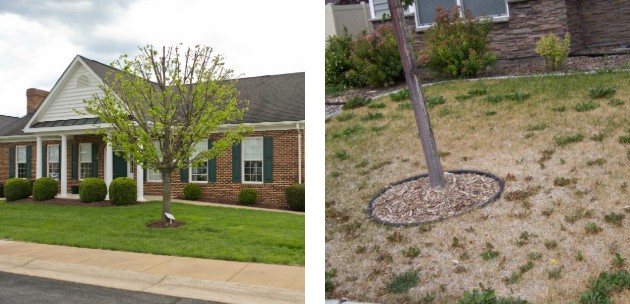
Lawn Care:
Best Practices: Regularly check for weeds, water and fertilize grass, and mow to maintain a cohesive and aesthetic appearance.
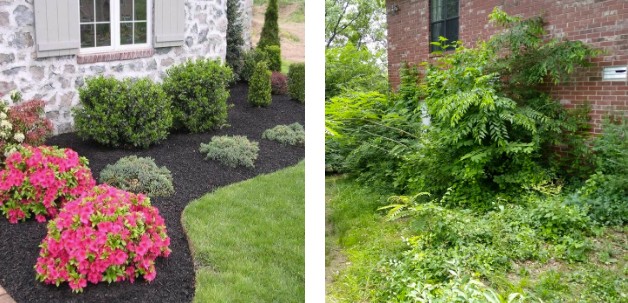
Landscape Bed Maintenance:
Daily Maintenance: Regularly check for weeds, deadhead flowers, and water as needed.
Weekly Maintenance: Trim and prune plants, remove debris, and check for pests.
Monthly Maintenance: Add mulch, fertilize, edge the area(s), and inspect soil.
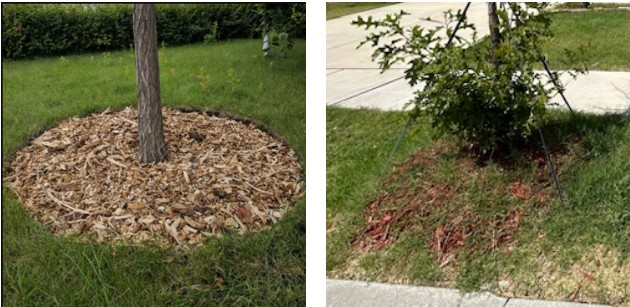
Tree Well and/or Ring Maintenance:
Best Practices: Avoid soil removal, use mulch, treat/remove weeds and overgrown grass, and ensure proper watering.
Purpose: Prevents trunk damage, regulates soil temperature, retains moisture, reduces competition from weeds, and maintains aesthetic appeal.
A common issue with these can be the presence of Tree Suckers. Tree Suckers are tiny shoots that look like mini trees emerging. When overgrown, they can create a shrub-like appearance.
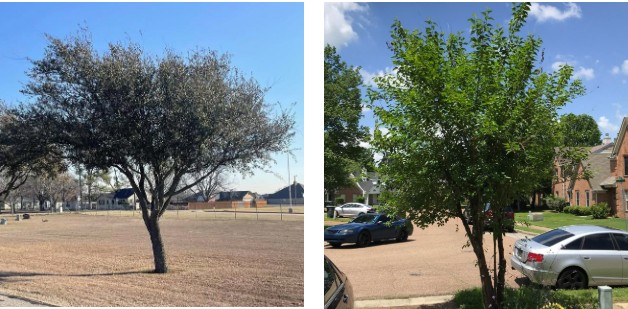
Canopying A Tree:
Purpose: Removing the lower branches of your tree(s) to raise the height of your tree canopy keeps the sidewalks clear for pedestrians and promotes tree growth.
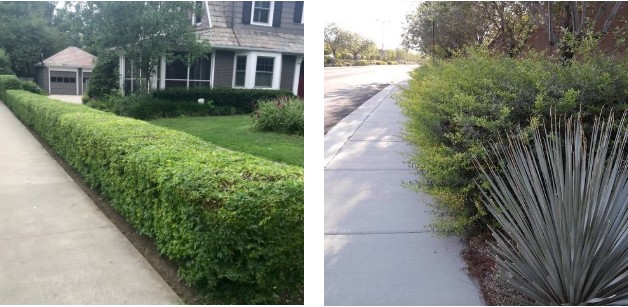
Bush Trimming:
Purpose: Trimming your bushes helps maintain curb appeal, ensures a clear walkway for pedestrians, and promotes healthy plant growth.
Leasing
Leasing in Artesia: A Quick Reminder
Artesia has specific requirements for leasing a home in our community. Below is a brief summary of the leasing policy. The complete policy is in Section 7.24, Leasing of Homes, of the Declaration of Covenants, Conditions & Restrictions, as amended by the amendment recorded in Denton County on January 14, 2021. Any owner considering leasing their home should review it carefully.
Leasing at a glance:
- Minimum term: Leases must be for at least six (6) months.
- Lease limit: No more than two (2) leases per home in any one-year period, unless approved in writing by the Board.
- Whole home only: Individual rooms may not be rented separately.
- No short-term rentals: Airbnb, VRBO, vacation, weekend, or event rentals are not permitted.
- Single-family use: Homes may only be leased for single-family residential use.
- Written lease: Leases must be in writing and state that the tenant is subject to the Association’s governing documents.
- Tenant copies: Owners must provide their tenant with a copy of the governing documents.
- Owner responsibility: Owners remain responsible for their tenant’s compliance.
- Submit within 10 days: A copy of the signed lease (sensitive information may be redacted) and the tenant/lease registration must be submitted within ten (10) days of the lease start date:
- For-rent signs: Signs advertising a home for lease require the Board’s prior written approval.
Questions? Contact us at ArtesiaTX@CCMCnet.com or (945) 418-1685.
Tree Reference Guide – Root Systems & Mature Size
Choosing the right tree starts with knowing how it grows, especially below ground. The table below is provided as a general reference only to help owners compare common North Texas trees by root system and mature size. This is not an approved or recommended list. Trees planted in the parkway (between the sidewalk and the curb) must be container-grown with a trunk of at least 3 caliper inches, measured 12 inches above grade (Declaration, Appendix B-12). If you are replacing a tree with the same species, no ASC request is needed. If you are planting a different species, please submit an ASC request before planting. We recommend consulting a certified arborist or nursery professional and calling 811 before digging.
| Root Category | Common Name | Botanical Name | Mature Size (H × W) | Notes / Root Considerations |
|---|---|---|---|---|
| Deep Roots | Bur Oak | Quercus macrocarpa | 60–80' × 60–80' | Very large tree; needs ample space |
| Deep Roots | Chinese Pistache | Pistacia chinensis | 30–40' × 25–35' | Fall color; drought tolerant |
| Deep Roots | Chinquapin Oak | Quercus muehlenbergii | 40–60' × 40–50' | Native; drought tolerant |
| Deep Roots | Lacey Oak | Quercus laceyi | 20–40' × 20–35' | Smaller native oak |
| Deep Roots | Shumard Red Oak | Quercus shumardii | 50–60' × 40–50' | Red fall color |
| Deep Roots | Texas Red Oak | Quercus buckleyi | 30–50' × 30–40' | Native; red fall color |
| Deep Roots | Bald Cypress | Taxodium distichum | 50–70' × 20–30' | May form knees in wet soils |
| Deep Roots | Texas Redbud | Cercis canadensis var. texensis | 15–25' × 15–20' | Small ornamental; spring blooms |
| Deep Roots | Mexican Plum | Prunus mexicana | 15–25' × 15–20' | Small ornamental; spring blooms |
| Deep Roots | Eve's Necklace | Styphnolobium affine | 15–30' × 15–20' | Small native ornamental |
| Moderate Roots | Cedar Elm | Ulmus crassifolia | 50–70' × 40–60' | Native; tolerant of local soils |
| Moderate Roots | Lacebark Elm | Ulmus parvifolia | 40–50' × 35–50' | Attractive peeling bark |
| Moderate Roots | Caddo Sugar Maple | Acer saccharum 'Caddo' | 30–50' × 25–40' | Heat-tolerant maple |
| Moderate Roots | Crape Myrtle | Lagerstroemia spp. | 10–25' × 8–20' | Fibrous, shallow roots; often multi-trunk |
| Spreading Roots | Live Oak | Quercus virginiana | 40–50' × 60–80' | Wide lateral roots may lift pavement |
| Spreading Roots | Sycamore | Platanus occidentalis | 70–100' × 50–70' | Large spreading roots; heavy leaf drop |
| Problematic | Bradford / Callery Pear | Pyrus calleryana | — | Invasive; weak branches prone to splitting |
| Problematic | Silver Maple | Acer saccharinum | — | Shallow, aggressive roots; brittle wood |
| Problematic | Cottonwood | Populus deltoides | — | Aggressive, water-seeking roots |
| Problematic | Weeping Willow | Salix babylonica | — | Aggressive roots may affect underground pipes |
| Problematic | Arizona Ash | Fraxinus velutina | — | Shallow roots; relatively short-lived |
| Problematic | Mimosa | Albizia julibrissin | — | Invasive; short-lived |
Important: Root growth depends on soil conditions, available space, irrigation, and proximity to structures. Even trees with deeper root tendencies may develop surface roots. This information is for educational purposes only and does not constitute Association approval. Please consult a qualified arborist when selecting a tree and obtain any required ASC approval before planting.
Approved Plant Material
The Declaration requires specific shrubs in certain locations, listed in Part 1. For all other landscaping, Part 2 is provided as a general reference only to help owners compare common North Texas shrubs by size and whether they stay green year-round. Part 2 is not an approved or recommended list. Replacing shrubs with the same type does not require an ASC request. New or different landscaping visible from the street may require approval, so please contact us before planting if you're unsure.
Part 1: Required by the Declaration
A/C equipment screening (Appendix B-16): A/C equipment outside the fenced backyard must be screened by a 5-foot fence, or by three 5-gallon evergreen shrubs planted about 6 feet in front of the unit plus one 10-gallon shrub about 3 feet from the side of the house.
| Required Size | Common Name | Botanical Name |
|---|---|---|
| 5-Gallon (Choose One) | Elaeagnus | Elaeagnus pungens |
| 5-Gallon | Holly | Ilex spp. |
| 5-Gallon | Nellie R. Stephens Holly | Ilex 'Nellie R. Stephens' |
| 10-Gallon (Choose One) | Yaupon Holly | Ilex vomitoria |
| 10-Gallon | Ligustrum | Ligustrum japonicum |
| 10-Gallon | Red-tipped Photinia | Photinia × fraseri |
Corner lots, side-yard fence along a street (Appendix B-15): Evergreen shrubs must be at least 3-gallon size and spaced every 4 feet along the fence. Part 2 below identifies common evergreen shrubs for reference. Homeowners should verify applicable Association requirements before planting.
Part 2: General Shrub Reference
The following table is provided for informational purposes only to help homeowners compare common North Texas shrubs by approximate mature height and evergreen status. Inclusion in this table does not constitute Association approval.
| Common Name | Botanical Name | Mature Height | Evergreen? |
|---|---|---|---|
| Abelia | Abelia × grandiflora | 3–6' | Semi |
| Anthony Waterer Spirea | Spiraea × bumalda 'Anthony Waterer' | 2–3' | No |
| Armstrong Juniper | Juniperus chinensis 'Armstrong' | 3–4' | Yes |
| Boxwood | Buxus spp. | 2–6' | Yes |
| Bridal Wreath Spirea | Spiraea cantoniensis | 4–6' | Semi |
| Burford Holly | Ilex cornuta 'Burfordii' | 10–15' | Yes |
| Cleyera | Ternstroemia gymnanthera | 8–10' | Yes |
| Columnar Juniper | Juniperus spp. (columnar forms) | 10–20' | Yes |
| Compact Nandina | Nandina domestica 'Compacta' | 3–4' | Yes |
| Cotoneaster | Cotoneaster spp. | 1–6' | Semi |
| Crimson Pygmy Barberry | Berberis thunbergii 'Crimson Pygmy' | 2' | No |
| Dazzler Holly | Ilex cornuta 'Dazzler' | 8–10' | Yes |
| Dwarf Burford Holly | Ilex cornuta 'Burfordii Nana' | 5–8' | Yes |
| Dwarf Chinese Holly | Ilex cornuta 'Rotunda' | 3–4' | Yes |
| Dwarf Crape Myrtle | Lagerstroemia indica (dwarf types) | 3–6' | No |
| Dwarf Yaupon Holly | Ilex vomitoria 'Nana' | 2–4' | Yes |
| Elaeagnus | Elaeagnus pungens 'Fruitlandii' | 6–10' | Yes |
| Encore Azalea | Rhododendron 'Encore' | 3–5' | Yes |
| Foster Holly | Ilex × attenuata 'Fosteri' | 15–25' | Yes |
| Gulf Stream Nandina | Nandina domestica 'Gulf Stream' | 3' | Yes |
| Harbour Dwarf Nandina | Nandina domestica 'Harbour Dwarf' | 2' | Yes |
| Indian Hawthorn | Rhaphiolepis indica | 3–5' | Yes |
| Nandina (Standard) | Nandina domestica | 6–8' | Yes |
| Needlepoint Holly | Ilex cornuta 'Needlepoint' | 10–15' | Yes |
| Rosy Glow Barberry | Berberis thunbergii 'Rosy Glow' | 4–5' | No |
| Texas Barberry | Berberis swaseyi | 3–6' | Yes |
| Wilson Holly | Ilex × altaclerensis 'Wilsonii' | 15–20' | Yes |
Evergreen Key: Yes = Generally retains foliage year-round; Semi = May lose some foliage during colder weather; No = Deciduous and typically loses foliage seasonally.
Important: Shrub sizes, growth rates, and foliage retention vary depending on soil conditions, weather, watering, and maintenance. This information is for educational purposes only and does not constitute Association approval. Please review the Association's governing documents and obtain any required ASC approval before planting.
Fall Lawn Care Reminder: Pre-Emergent Weed Control
Fall is an excellent time to take proactive steps toward maintaining a healthy, beautiful lawn. Applying a pre-emergent weed control product can help prevent unwanted weeds from taking hold by creating a protective barrier in the soil that stops weed seeds from germinating.
For the best results, timing is important! In North Texas, fall pre-emergent applications are generally most effective as soil temperatures begin to cool, typically in September or early October. Application timing may vary depending on weather conditions, so monitoring soil temperatures and following product instructions is recommended.
Taking these preventative steps can help reduce winter and early spring weeds, giving your lawn a healthier start to the growing season.
A little preparation now can make a big difference in keeping Artesia's lawns looking their best year-round!
Mailboxes
Mailboxes are one of the first things neighbors and guests see, and they play a big part in Artesia’s curb appeal! Each homeowner is responsible for keeping their mailbox and post in good condition.
Mailbox maintenance checklist:
- Keep the mailbox and post upright, secure, and level.
- Repair or replace dented, rusted, faded, or damaged mailboxes, doors, flags, and posts.
- Keep address numbers clear, legible, and in good condition.
- Touch up peeling or faded paint on the box and post.
Replacing your mailbox? To keep a consistent look throughout the community, mailboxes and posts should match the existing style, size, and color used in Artesia. Changes to the style, color, or location of a mailbox, or decorative additions, require prior approval from the Architectural Standards Committee (Declaration, Appendix B-13 and B-14). Please submit an ASC request before making changes: Residential Modification Guidelines.
Damaged by a vehicle or storm? Homeowners must repair mailbox damage caused by a vehicle or storm. If someone else damaged your mailbox, you may want to contact your homeowner’s insurance or the responsible party. For mail delivery issues, please contact your local Post Office.
Questions? Contact us at ArtesiaTX@CCMCnet.com or (945) 418-1685.
Mulch Bags
As a friendly reminder, we kindly ask that any bags of mulch currently stored in driveways be relocated to your garage or backyard. Thank you for helping maintain the neat and welcoming appearance of our community!
Permanent Trim Lights – Did You Know?
Did you know that permanent outdoor trim lights (such as roofline or eave lighting systems) require approval from the Architectural Standards Committee before installation? If you didn’t realize approval was needed, or life just got busy, no worries! Simply fill out the online application and include a photo of your lights:
We’ll get your application to the committee for review.
What the Declaration says:
- Approval required: Exterior lights and fixtures are subject to prior approval of their design, color, and location (Appendix B-13 and Section 6.4).
- Everyday lighting must be white: “All exterior light must be in shades of white. Color lights and sodium vapor lights are prohibited.” Exterior lighting should be unobtrusive, shielded to prevent glare, and directed away from neighboring homes, with no spillover onto neighboring property (Section 7.25).
- Holiday colors are welcome during the holidays: Colored lighting displays are permitted during holiday periods, from 7 days before through 7 days after a holiday, and for Christmas from the day before Thanksgiving through the day after New Year’s Day (Section 7.20).
In short: Permanent trim lights may display colors during holiday periods. At all other times, please set them to white.
Questions? Contact us at ArtesiaTX@CCMCnet.com or (945) 418-1685.
Parking Reminders
Parking multiple cars on the street has become a concern in parts of our community, making it difficult for residents, delivery vehicles, and emergency vehicles to get through the neighborhood. Please use your garage and driveway before parking on the street, and please be mindful of your neighbors and of local traffic and parking laws. Together, we can keep Artesia’s streets safe, accessible, and looking their best.
CC&R Spotlight: Section 7.28, Parking
“Residents are expected to park their vehicles in their garages, and use their driveways for overflow parking… Unless and until the board adopts different rules for street parking, (1) without board approval, no vehicle may be parked on an Artesia street for more than 3 consecutive days and/or nights, and (2) with board approval, no vehicle may be parked on an Artesia street for more than 7 consecutive days and/or nights. Moving the vehicle during the day but parking on the street at night constitutes one day. No vehicle may be parked in a manner that may impede access to homes in Artesia by an emergency vehicle.”
Parkway Trees
The most common violations in Artesia relate to lawn maintenance and the upkeep of parkway trees. Owners are required to maintain the yards on their lot, including any unpaved portion of the right-of-way along the street, “at a level, to a standard, and with an appearance that is commensurate with the neighborhood” (Declaration, Section 13.2(b)). This includes:
- Maintaining an attractive ground cover or lawn on all yards visible from a street
- Edging street curbs and mowing at regular intervals
- Keeping lawn weeds and grass under 6 inches in height
- Maintaining an attractive appearance of shrubs and trees visible from a street
- Replacing plant material, as needed, to maintain the minimum landscaping requirements
Dead or diseased trees, shrubs, or landscaping should be removed and replaced within a reasonable time.
Parkway Trees
Parkway trees are part of Artesia’s original community design and are required by the Declaration. Each owner is responsible for maintaining and, when needed, replacing the parkway tree on their lot. Parkway trees provide many benefits, including shade, curb appeal, and property value, and they help reduce energy costs and neighborhood noise. Choosing an appropriate tree species, along with proper watering and care, can help reduce the risk of roots affecting sidewalks, curbs, and utilities.
Requirements (Declaration, Appendix B-12):
- Location: In the parkway, between the sidewalk and the back of the curb
- Quantity: At least one tree in the front parkway
- Corner lots: Three additional trees along the side-yard parkway
- Type: Container-grown
- Size: Trunk at least 3 caliper inches (corner side-yard trees at least 2 caliper inches), measured 12 inches above grade
Replacing a parkway tree? If you’re replacing a tree with the same species, no ASC request is needed. If you’d like to plant a different species, please submit an ASC request before planting: Residential Modification Guidelines. Please call 811 to have utilities marked before digging.
| Common Name | Botanical Name | Mature Size (H × W) |
|---|---|---|
| Chinese Pistache | Pistacia chinensis | 30–40' × 25–35' |
| Cedar Elm | Ulmus crassifolia | 50–70' × 40–60' |
| Shumard Red Oak | Quercus shumardii | 50–60' × 40–50' |
| Texas Red Oak | Quercus buckleyi | 30–50' × 30–40' |
| Lacebark Elm | Ulmus parvifolia | 40–50' × 35–50' |
| Live Oak | Quercus virginiana | 40–50' × 60–80' |
| Texas Redbud | Cercis canadensis var. texensis | 15–25' × 15–20' |
Common Parkway Tree Choices in North Texas: The trees listed above are provided for general reference only and do not constitute an approved or recommended planting list. Please see our Tree Reference Guide for additional information about root systems, mature sizes, and planting considerations.
Requirements (Declaration, Appendix B-12):
- Location: In the parkway, between the sidewalk and the back of the curb
- Quantity: At least one tree in the front parkway
- Corner lots: Three additional trees along the side-yard parkway
- Type: Container-grown
- Size: Trunk at least 3 caliper inches (corner side-yard trees at least 2 caliper inches), measured 12 inches above grade
Replacing a parkway tree? If you’re replacing a tree with the same species, no ASC request is needed. If you’d like to plant a different species, please submit an ASC request before planting: Residential Modification Guidelines. Please call 811 to have utilities marked before digging.
Common parkway tree choices in North Texas (for reference only; not an approved list): Chinese Pistache, Cedar Elm, Shumard Red Oak, Texas Red Oak, Lacebark Elm, Live Oak, and Texas Redbud. See our Tree Reference Guide for root systems and mature sizes.
Sidewalks
Did you know? Homeowners are responsible for maintaining and repairing the sidewalks along their lot. Under Section 13.2(a) of the Declaration, “each owner, at the owner’s expense, must maintain all improvements on the lot, including but not limited to the dwelling, fences, sidewalks, and driveways.”
Sidewalk repair requirements (Declaration, Appendix B-18):
- Sidewalks along all street frontages must be at least 4 feet wide.
- “All repairs and replacements to the sidewalks must be done using the same type and color of materials so that such sidewalk(s) does not appear to have been repaired or replaced.”
- No characteristic of the sidewalk, including its location and materials, may be changed without the prior written consent of the Water District.
Who maintains what? Artesia is served by Denton County Fresh Water Supply District No. 10, which provides many city-type services, such as streets, drainage, and water and sewer. In certain cases, the District may cover major repairs (for example, a sinkhole beneath the sidewalk caused by a storm drain or utility issue). A good rule of thumb:
- If the builder or homeowner installed it, the homeowner maintains it: the house, fences, driveway, sidewalk, and landscaping.
- If the Water District installed it, the District maintains it: streets, storm drains, drainage systems, and water and sewer lines.
If you notice a sidewalk issue that may be caused by a District-maintained system, such as sinking or collapse, please contact the Water District directly at Elm Ridge Water District.
Questions? Contact us at ArtesiaTX@CCMCnet.com or (945) 418-1685.
Trash Bins
Trash, recycling, and yard waste containers must be stored inside the house, garage, or fenced yard and may not be visible from the street or neighboring homes.
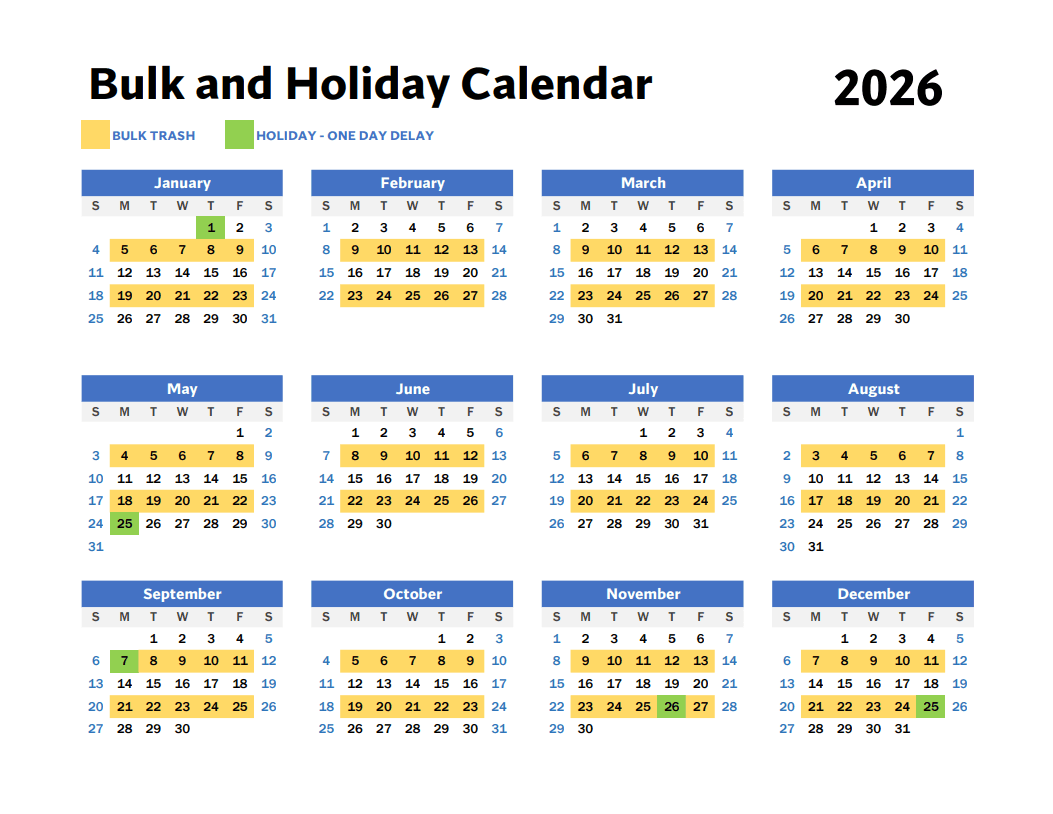
Trash day is Thursday. Containers may be placed at the curb no earlier than dusk the evening before trash pickup and must be returned to storage by dusk on trash pickup day.
CC&R Spotlight: Section 7.36, Trash
“Each resident will endeavor to keep the Property clean and will dispose of all refuse in receptacles designated specifically by the Association or by the solid waste disposal contractor for that purpose. Trash must be placed entirely within the designated receptacle… If the rules fail to establish hours for curbside trash containers, the container may be in the designated area from dusk on the evening before trash pick-up day until dusk on the day of trash pick-up. At all other times, trash containers must be kept inside the house, garage, or fenced yard and may not be visible from a street or another lot or condominium unit.”
Quick tips:
- Keep all trash bagged and fully inside the container with the lid closed.
- Storing cans behind your side-yard fence or gate is a great way to keep them out of view.
- Trash service in Artesia is provided through the Water District’s contracted provider. For missed pickups, bulk trash, or replacement carts, please click here.
Questions? Contact us at ArtesiaTX@CCMCnet.com or (945) 418-1685.
Tree Trimming
As a reminder, it is each owner’s responsibility to maintain the trees and shrubs on their lot, including the parkway tree between the sidewalk and the street. Under Section 13.2(b)(vi) of the Declaration, owners must “maintain an attractive appearance of shrubs and trees visible from a street.”
Safety first: stop signs and sidewalks
Trees and shrubs should never block the view of stop signs, street signs, or intersections. Clear visibility helps prevent accidents and keeps our community safe for drivers, cyclists, and pedestrians. Please also keep sidewalks clear, so all residents, including those with strollers or wheelchairs, can walk comfortably.
Recommended clearances:
- Over sidewalks: raise the lower canopy to approximately 7–8 feet
- Over the street: approximately 14 feet, so vehicles, delivery trucks, and trash trucks can pass
- Around the home: keep branches off the roof and away from the house
- Signs and intersections: keep stop signs, street signs, and corner sightlines fully visible
These clearances are general recommendations to help owners plan their trimming. The Association looks at the overall appearance, safety, and accessibility of trees visible from the street.
When to trim
The best time to trim most trees is during the dormant season, generally late fall through early spring. Trimming during this time minimizes stress on the tree and promotes healthy growth. Oak trees in North Texas should be pruned between July and January, avoiding February through June, to reduce the risk of spreading oak wilt.
Trimming tips
- Remove dead, broken, or crossing branches.
- Raise low limbs gradually, rather than removing large limbs all at once.
- Avoid “topping” trees, which weakens them and causes unattractive regrowth.
- Please don’t remove your parkway tree. Each home is required to have a parkway tree (Declaration, Appendix B-12). If your tree is dead or diseased, it must be replaced with a container-grown tree of at least 3 caliper inches.
- If you’re unsure whether your trees need trimming, consider consulting a certified arborist.
We understand that tree maintenance takes time and effort, and we appreciate everything you do to keep Artesia safe and beautiful. Thank you for your cooperation and commitment to our community!
Questions? Contact us at ArtesiaTX@CCMCnet.com or (945) 418-1685.